Photographs are an integral part of our daily lives, from sensationalist images in tabloid papers, to personal family snapshots, to the art photography displayed in galleries and sold through international art markets. In this thought-provoking exploration of the subject, Steve Edwards provides a clear, lively, and imaginative approach to the definition, importance, and meaning of photography. He combines a sense of its historical development with an analysis of its purpose and meaning within a wider cultural context.

Photography is a process of recording visual images by capturing light rays or on a light-sensitive recording medium (e.g film or digital CCD). It can be thought of as two pursuits :
- Technical: The science of setting up the camera and the recording medium to take images in a controlled way.
- Creative: The art of composing good images to capture.
There are dozens of different types of photography. Some areas require specialist knowledge (e.g. scientific photography), but almost all photography involves the same basic principles of obtaining a clear, focused image through a lens and onto the recording medium.
There are also many types of camera. Professional photographers like to have a selection of cameras for different purposes. The most popular type of general-purpose camera for taking high-quality images is the single lens reflex (SLR). If you are interested in photography you will probably want to own an SLR camera.
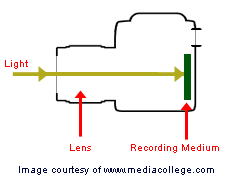
Traditional photography uses film as the recording medium, which is a chemical process. Modern photography is heavily geared towards digital photography, which is an electronic process. In either type of photography the basic process is the same, as illustrated in this (over-simplified) camera diagram:
A critical part of the camera is the optical element, i.e. the lens. The role of the lens is to take incoming light rays and bend them to form a clear image on the recording medium. The structure of the lens determines how much the light is bent and the magnification of the resulting image. To understand photography, you need to understand lenses.
Like all arts, good photography comes with practice. Learn about the camera, learn about picture composition, and practice.


 Love's Blog